Tell About the Real Saint Patrick

St. Patrick's Day is on Monday, March 17. Be sure to take time this weekend to explain to your children who the real St. Patrick was, and why he should be a type of Hebrews 11 example of faith.

There are a lot of articles that you can use, but here is a great post from a couple of years back, from The Resurgence Blog, called Get to Know Saint Patrick.

Here are some key things I learned from this article:
  • Patrick was never an official saint.
  • He was English, not Irish.
  • He was a rebellious non-Christian teenager who had come from a Christian family.
  • God told him (in a dream) to escape from his slavery.
  • After being trained as a pastor, God told him (in another dream) to return to Ireland to preach the gospel.
  • In his ministry to the Irish people, he saw thousands of converts, trained 100 pastors, and planted 700 churches.
  • He "was the first noted person in history to take a strong public stand against slavery."

Read the full article by Mark Driscoll.

You can also see this short video from Rose Publishing:


Related Links:
**image courtesy of dimitri_c via sxc.hu

Who Is Marriage For?

15 years ago today, Joanna and I went on our first date. (We actually began our dating relationship 8 days earlier, but because of school/work/ministry commitments, we didn't get to go out on an "official" date until the following week.)

It was a quick courtship, as we got engaged on July 18, and then we were married on December 11. We definitely have learned a lot about each other and ourselves in the past 15 years, and I'm blessed to have a wonderful wife.

Not About Me?

One weekday morning years ago, I read a certain chapter in What Did You Expect?? (Paul Tripp), the best marriage book I've ever been through. In that particular passage, Tripp helped me see the truth that I entered into marriage with selfish motives.

I pursued Joanna, and was thrilled to marry her. But if I'm honest, I was thrilled to marry her because of how she made me feel. She made me feel great about myself, and our relationship, courtship, and marriage only solidified my selfish wants.

Of course, I would tell others that it wasn't about me, and that I was called to pursue, provide, and protect. But down in my heart, I went into marriage mostly for self-focused reasons.


Marriage Is About Others

Seth Adam Smith shares advice he received from his dad, in Marriage Isn't For You:
"I’m going to make this really simple: marriage isn’t for you. You don’t marry to make yourself happy, you marry to make someone else happy. More than that, your marriage isn’t for yourself, you’re marrying for a family. Not just for the in-laws and all of that nonsense, but for your future children. Who do you want to help you raise them? Who do you want to influence them? Marriage isn’t for you. It’s not about you. Marriage is about the person you married."

He is correct, and I needed these truths 15 (or more!) years ago. Believing that marriage is about oneself leads to lack of full commitment, because when that person doesn't feel like it's fulfilling his or her needs, that is reason to look elsewhere for companionship.

But I think Seth is missing something. Sure marriage isn't about me, but it's not really about others either. Marriage is about God.


Marriage Is About Jesus

Let me restate: our marriage isn't for me or for my wife. It's actually about Jesus. I ought not to go through my marriage with the aim of pleasing myself, and I shouldn't even aim to please Joanna. My aim should always be to please the One who made me and died for me.

(Of course, not everyone (particularly, those who don't follow Christ) will believe that their marriage is about God. For them, I would at least encourage them to make their marriages more about their spouse then themselves. It is better than a self-focus, though that bond will usually be frail.)

You see, when I spoke my vows to Joanna, I didn't just commit to her. I committed myself to Jesus. I committed to my wife in the grace and power of the Lord. My promise to Joanna is rooted in my faith in God. Therefore, to break my vows to love Joanna would be equal to breaking my vows to God.

Husbands and wives -- don't make your own desires the focus of your marriage. At a bare minimum, focus on loving and serving your spouse. But if you want a full satisfaction in your marriage, pursue Jesus and make your marriage about Him.

Dustin Crowe agrees:
"We cannot love children or spouses well unless the perfect love of the Father is a first-hand experience." 


Related Links:

4 Ways that Good Dads Make a Difference


Are men needed to raise children? No. Just ask single mothers.

Are Dads easily dispensable? Also a "no." And research shows it.

Bradford Wilcox wrote a fascinating and insight article for The Atlantic  -- The Distinct, Positive Impact of a Good Dad. He acknowledges that mothers and fathers both play crucial roles, that go beyond cultural expectations.

"Fathers often engage their children in ways that differ from the ways in which mothers engage their children. Yes, there are exceptions, and, yes, parents also engage their children in ways that are not specifically gendered." 

 Specifically, there are four contributions that are distinctively (though not exclusively) from fathers:
  1. Play. "Fathers typically spend more of their time engaged in vigorous play than do mothers, and play a uniquely physical role in teaching their sons and daughters how to handle their bodies and their emotions."
  2. Risk. "Fathers are more likely to encourage their children to take risks, embrace challenges, and be independent, whereas mothers are more likely to focus on their children's safety and emotional well-being."  
  3. Protection. "Fathers . . . appear to be more successful in keeping predators and bad peer influences away from their sons and daughters." 
  4. Discipline. "Fathers tend to be more willing than mothers to confront their children and enforce discipline. . . . By contrast, mothers are more likely to reason with their children, to be flexible in disciplinary situations, and to rely on their emotional ties to a child to encourage her to behave. . . . Mothers and fathers working together as co-parents offer a diverse yet balanced approach to discipline."

Note that this author is not saying that fathers are more important than mothers, or vice versa. The point is that there is a unique contribution that each has the potential to bring.

Wilcox concludes the article by showing specific effects that good days have, with respect to the child's behavior and actions. This data matches up perfectly with what I have been learning, and which I've written about here:

Dads and Moms alike -- keep giving your children what they need, in the unique way that God has made you.


Related Links:

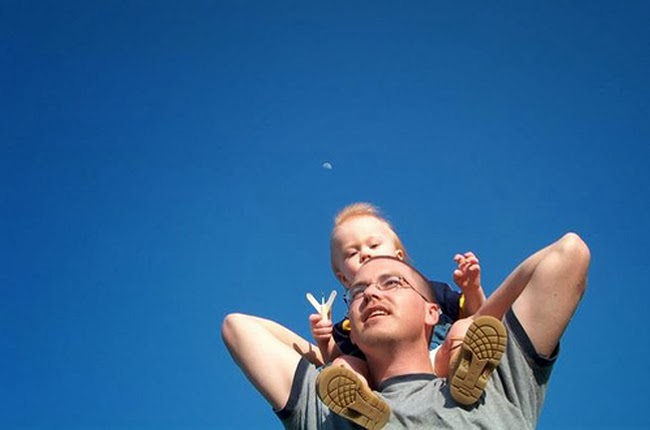
**image courtesy of thefixer via flickr and The Atlantic

Perfectionism and Birth Order

Look at this mess I created.

I recently finished Have a New Kid by Friday (Dr. Kevin Leman), and will post a review soon. (Hint: you probably shouldn't buy it.) But at least one part in particular hit close to home.

You've probably heard about birth order theory -- which states that the rank and order of children affects their personalities. And you may have read my own Birth Due Date Theory, which may be completely subjective.

Here is what Dr. Leman writes (p. 221):
"In many families, the firstborns are the achievers -- the ones who are born to fly high in their adult life. They're the adults who always hit the home runs and become airplane pilots, civic leaders, surgeons, etc.
But let's say that the firstborn has an overly perfectionistic parent. Then the firstborn will become a procrastinator. There's a role reversal that happens as the firstborn takes the initial emotional hit from a perfectionistic parent."
This is exactly what we see in our family. Hannah, our oldest, is a procrastinator and not very organized. And Dr. Leman is probably correct here -- that this was caused, at least in part, by Joanna and I. Hannah has TWO perfectionistic parents. Poor girl -- she had no chance!

He continues:
 "Then it's the secondborn who becomes the superachiever -- the self-motivated, mature, in-control-of-life person who proceeds through life with great skill and ability -- while the firstborn flounders in expectations. This phenomenon plays itself out in life, especially when there are 3 years or less between the firstborn and the secondborn."

And this is what we see with Elijah. He is orgnized, self-motivated, academically gifted, and in-control (probably too much so). And Hannah and Elijah are only 26 months apart, so they fit within Dr. Leman's 3-year timeframe.

A final word of caution and encouragement:
"If your child thinks he can't measure up to your standards, he won't try. Or he'll try only so far and won't get to the finish line. . . . If you're a perfectionistic parent, your child knows he can jump higher and higher for you . . . and never win your praise."
That's the final, and deepest, cut. As we demand more and more perfection out of our children, we are building a wall around their hearts and souls.

We can't rewind the clock, but we can ask God to help us be more grace-filled as we go forward. It's never too late.

Do you see this in your family? Do you have a high-achiever firstborn? Or, like us, do you have a procrastinator firstborn and high-achieving secondborn? Would love to hear from you in the comments.


Related Links:


Favorite Tweets for February

Capture the moments of your life!

February brought to our family:
  • A church leaders retreat in the mountains.
  • A postponed robotics tournament due to weather-related issues. (Irony: the theme is "Nature's Fury.")
  • Valentine's Day.
  • Final preparations for the cast (including my wife and three kids) and crew of Salkehatchie Stew.
Did you miss these snapshots from this past month?


From Others:

@MarkMerrill:  Starting today, make it a priority to set aside time for what’s ultimately important: your child

@JonAcuff:  Paul Allen of Microsoft owning the Seahawks is a huge inspiration to any computer nerd who was ever bullied by a jock.

@Jonnie_W:  "I don't care if the court is iced over. I wanna play shuffleboard!" -Old Man, Accidentally Inventing Olympic Curling 

@GraceChurchSC:  My biggest problem is not my sexual identity but my sinful identity. - Peter Hubbard

@Memverse:  Blessings Too Big: "When God said that children were a blessing, he wasn’t kidding." via |   

@lecrae:  If refuse to endure struggle, you refuse to embrace progress.

@NikkiHaley:  I would be fine if we never had another winter storm. I much prefer the 80 degrees we are having today!

@abbyelisemoore:  "When the self gets elevated, the mission gets lost."

: "Coexist. Or else."

From Me:

Love having a daughter whose first words in the morning are, "I'm going to make muffins for breakfast."

Got to have a party with the guys I've been working with in the prison. They provided snacks.

Historic Grove Park Inn, where you can purchase historic technology.

"…But the Lord…" // An encouraging reminder from

Reason 78 Is Better Than Where You Live: No .   

In contemporary Christianity, we are in more danger of playing it safe than we are of being reckless. () 

I'm excited to partner with the Dosters in Eleuthera!

My wife realized that when our son "Sender" starts using email, it's going to be really confusing for him & the other person.  

New Skill: Making Music to My Ears

When I was a senior in college, I took "Group Piano for Beginners." (Along with my twice-per-week volleyball class, and taking "Old Testament", it was probably my easiest quarter at Furman University). I was anticipating being semi-proficient in piano by the end of the 8-week term.

I practiced almost every day, probably not as much as I should have, but I did practice. Nonetheless, I could not convince my hands to do two different things at the same time.

When we had class, the teacher would call on students to show their skills. Only a couple of weeks into class, she realized that she could only call on me for the simplest examples. Needless to say, my hopeful outlook for piano proficiency was crushed.

Piano: Strike 1.

The next year, I wanted to try to learn the harmonica. I asked for (and received) a couple of them as gifts, plus some instruction books. I practiced a total of about 20 minutes. Honestly, I thought it would be like a recorder, or a kazoo.

Harmonica: Strike 2.

Third Time's the Charm? 

As you may remember, my goal in 2014 is to learn new skills by committing 20 hours over 2 months. I have had a great time re-learning Spanish (see below for more on this), and for March and April, I will try to learn to play another instrument: the ukulele.

Thanks to a helpful salesman at the Guitar Center in Greenville, SC, I got a good deal on a decent (not the worst, not the top-line) ukulele, plus a case, instruction book, etc. I'm ready to get started!

Why Learn an Instrument?

There are many reasons to learn an instrument. (Of course, the most dramatic effects come when you train on an instrument as a child, but better late than never!). Here are a few benefits of music training: 

But I'm not doing it for these reasons. I'm just doing it for the sheer pleasure of it. Not the pleasure of music, since I don't listen to music very much (90% of the time when I'm alone in my car, the radio is off).

I'm talking about the pleasure of dedicating myself to a goal, and accomplishing something. I want to give it an honest go this time, not just a half-hearted effort I gave with piano, and a 1%-hearted effort I gave to the harmonica.

How good will I become in just 8 weeks (and 20 hours of training)? Not great, I'm sure. But I have to remember that it's about the process, not the goal.

And I'm inspired by the Portsmouth Sinfonia, and group of untrained but eager musicians.


If a group like this reforms (they stopped performing after 9 years because they got too good), maybe they could use my ukulele skills!


Spanish

As you may remember, our family started learning Spanish (or for me, "re-learning") this year. It has been fun for our entire family, especially as we incorporate occassional words, phrases, and sentences in our everyday life.

Because of the pace at which I've been going (30 minutes a day, 5 days per week) and that I began in December, I'm already 70% done with the material for Year 1. I will keep going with my Spanish training for the rest of 2014, but at a slower pace.

In both these new skills -- Spanish and music -- please wish me "Buena suerte!"

How about you? Are you learning any new skills this year?


Related Link:

Is There a Good Devotional Book for a 5th Grader?

A few months ago, I got a question from a friend, who is a small group leader (in church) to a group of boys:
"Do you of a good devotional or book for a 5th grade boy? His parents say he is a rule follower who has recently committed himself to Christ, but they want something that will point his eyes up to who God is -- what He has done for us, and how He works through us, rather than something that focuses on our behavior." 

I told him that I don't know of any good books that a boy this age could read on his own, and come to this understanding himself. At this age, the child is still in a phase where the parents must teach, lead, explain, and point to Jesus.

Another thing is that I'm not a huge fan of most devotionals and children's storybook Bibles. I find most of them (especially youth devotions) to be weak in theology, and they tend to focus on works, instead of on abiding in Christ and trusting in the gospel.

I do know of some great resources (for example, the Jesus Storybook Bible and curriculum from The Gospel Project), but not anything that a 10 year old could read, and say, "Oh. Now I get it!"

Even my favorite Bible storybook (especially for young boys), The Action Bible, doesn't so much point to the sufficiency of Christ, as it captivates young minds with lots of action in God's word. Other good resources that can help a child grow in his or her faith (though not specifically point him to the gospel) are:

If there is one parenting resource I would recommend above all others, it is Big Truths for Young Hearts. But again, it is something that the parents must read and explain to their kids, in about 10-minute segments. I've written about this book before:

But the biggest piece of advice I have for all parents who are concerned about this issue is, "Don't stress out." Like me, many Christian parents think, "I want better teaching for my children than I had as a child. So, I have to get this perfect."

We need to remember that discipleship is a long-term process. It's not one book or one conversation, but a string of conversations and activity that will help our children trust in Jesus. As I wrote in Don't Be a Seasonal Christian Parent, the tools we use to disciple our children are not nearly as important of just doing something, and continually teaching and training them in the Lord (Ephesians 6:4).

Of course, I may be missing some good resources. Would you please let me know if you know of any books or devotionals that a 5th grade boy could read on his own, to point him to Jesus?

Thanks for your help!

Related Links: